In my movie reviews, I give my brief thoughts on what I watched. Sometimes I will expound on those thoughts, but more often than not, I will just give a brief opinion. You can read plot descriptions on Internet Movie Database or on Amazon.
Mr. Hobbs Takes a Vacation, Starring Jimmy Stewart, Maureen O'Hara, Fabian, Laurie Peters. 1962.
If It's a Wonderful Life has a sequel, then that sequel is Mr. Hobbs Takes a Vacation.
During his career, Stewart played the main characters in three “Mr.” films. The first was Mr. Smith Goes to Washington (1939), and the second was Mr. Hobbs Takes a Vacation (1962), which is about the changing family dynamic as children grow up. In the third, Mr. Krueger’s Christmas (1988), Stewart plays a lonely janitor who finds the true meaning of Christmas.
Mr. Hobbs Takes a Vacation is full of references to It’s a Wonderful Life. There are so many of these references, that the film is almost an homage to the classic, or a sequel that looks at the question, “what happened next to the Bailey family?” While the film concerns the Hobbs family, and not the Baileys, the connections are still there.
Mr. Hobbs and George Bailey both have daughters named Janie. Another daughter is named Suzie. While not an exact match, the similarity to the name Zuzu is close enough to make one pause to consider the connection.
Source: http://goo.gl/vL0mHJ
The Hobbs family vacations together at a beach house during a trip that Mrs. Hobbs (Maureen O’Hara) calls the “chance of a lifetime,” echoing Sam Wainwright’s claim about the job he offers George in It’s a Wonderful Life. However, they find that the beach house is not as nice as they expected it to be. In fact, the Hobbs family finds a house that is dirty, run-down, and appears to be haunted, reminiscent of the Granville House after the graduation dance at the high school.
The house even has a mansard roof and a troublesome newel post, which served in It’s a Wonderful Life as both a tool to break the tension of several scenes, and as a symbol of George Bailey’s growing frustration. In Mr. Hobbs Takes a Vacation, the newel post is a light-hearted tribute to the older film. The joke is extended when Mr. Hobbs attempts to climb the stairs and one of the steps breaks.
In It’s a Wonderful Life, just before Sam Wainwright offers George the job, Sam tells him of an idea for a factory that he wants to build in Rochester, New York. In Mr. Hobbs Takes a Vacation, Mr. Hobbs tells his down-on-his-luck, unemployed son-in-law to look for a job in Rochester.
During a social event at a yacht club, Mr. and Mrs. Hobbs become concerned about their youngest daughter Katey (Lauri Peters). Mr. Hobbs becomes so concerned that his wife becomes worried about him. He tells her, “Don’t worry. I’m not gonna’ jump.” This is a reference George Bailey’s perceived solution to his funding shortage problem in It’s a Wonderful Life.
Mr. Hobbs remedies his daughter’s problems by hiring a dance partner for her. It is a move that causes his wife to berate him for “giving $5 to some guy you don’t know from Adam.” The statement echoes Nick, the bartender at Martini’s bar during the Pottersville sequence, who says he doesn’t know George “from Adam’s off ox.”
Mr. Hobbs goes bird watching with a visitor to the summer home. Every time he sees a bird, he asks what kind it is, only to learn that it is always the same species. Every time he sees the bird, thinking it is a new species, he comments, “well, what do you know about that,” which is one of George Bailey’s favorite phrases.
Mr. Hobbs is more cynical than George Bailey, but the children are older. He looks through travel brochures for the Caribbean, France, Britain, and Hawaii. This reminds one of the travel brochures George Bailey carries with him.
In a connection that hits closer to real life, Mr. Hobbs refers to being buried in Woodlawn Memorial Cemetery. In real life, Stewart is buried in Forest Lawn Memorial Park, in Los Angeles, CA. There is a real Woodlawn Cemetery in Santa Monica, CA.
In my movie reviews, I give my brief thoughts on what I watched. Sometimes I will expound on those thoughts, but more often than not, I will just give a brief opinion. You can read plot descriptions on Internet Movie Database or on Amazon.
The Greatest Show on Earth, starring Betty Hutton, Cornel Wilde, Charlton Heston, Jimmy Stewart, and Gloria Graham. 1952.
This film is about masks. Masks and hiding. Masks and hiding and trust. Masks and hiding and trust and coming to your own conclusions. Not necessarily in that order.
In the film, Jimmy Stewart plays a man on the run. He always stays in character and he always stays in face paint. The movie really is not about Stewart's character. Instead, it is about the cooperation and family relationships that are built in the circus. Stewart is the illustration of this cooperation and dedication.
In my movie reviews, I give my brief thoughts on what I watched. Sometimes I will expound on those thoughts, but more often than not, I will just give a brief opinion. You can read plot descriptions on Internet Movie Database or on Amazon.
Jefferson Smith is the head of the Boy Rangers, a thinly-veiled revision of Cub Scouts.
This is a classic "little guy" film.
Stewart's performance is tops. It's a very emotional experience to watch him fall apart during the culmination of the film.
And of course, Beulah Bondi plays his mother. Again. And they sing "Auld Lang Syne". Again. And the same actors appear. Again, including Thomas Mitchell. And H.B. Warner. And Bondi. And those are only actors from It's a Wonderful Life. That doesn't take into consideration actors from other Capra and Capra/Stewart films.
Watch the trailer here:
This film is amazing, and my second-favorite Stewart film. And my second-favorite Capra film, too.
Frank Capra and James Stewart worked together on three film projects: You Can’t Take it With You (1938); Mr. Smith Goes to Washington (1939); and It’s a Wonderful Life (1947).
In You Can’t Take it With You, which was Capra’s and Stewart’s first film in the “trilogy,” Capra began examining the idea of the happiness money brings — or fails to bring — to an individual, and by extension, to his family. The main struggle in the film is between the happy-go-lucky Vanderhof family and the Kirby clan. The Kirbys want to purchase and raze the Vanderhof home, along with other surrounding homes, in order to build build a munitions factory.
Early in the film, one of the main characters, Grandpa Vanderhof, portrayed by Lionel Barrymore, talks about “Ism-mania.” Here, we begin to see Capra’s feelings toward America, its government, and its people through Grandpa Vanderhof: “Communism, Fascism, voodooism. Everybody’s got an ‘ism’ these days. When things go a little bad nowadays, you go out and get yourself an ism and you’re in business.”
His daughter, Penny, wonders aloud if the character in the book she is writing should have an “ism.” Grandpa Vanderhof responds to her idea: “Give her Americanism. Let her know something about Americans: John Paul Jones, Patrick Henry, Samuel Adams, Washington, Jefferson, Monroe, Lincoln, Grant, Lee, Edison, Mark Twain. When things got tough for those boys, they didn’t run around looking for ‘isms.’ Lincoln said, ‘with malice toward none and charity to all.’ Nowadays, they say ‘think the way I do or we’ll bomb the daylights out of you.’”
Listen to the exchange here:
Already in You Can’t Take it With You, we see not only Capra’s strong American sentiment, but also a strong aversion to aggression by the strong against the weak. Capra also establishes his overarching “umbrella” theme for all three films (You Can't Take it With You, Mr. Smith Goes to Washington, and It's a Wonderful Life) by quoting Lincoln. Boiled down, this theme is Biblical in nature: “love thy neighbor.”
Another repeating Capra/Stewart theme we see for the first time in You Can’t Take it With You is the value of friendship. The Vanderhof family has many friends throughout the community. They are disarming and charming, and we are able to see that through Mr. DiPinna (Halliwell Hobbes) and Mr. Poppins (Donald Meek), who are brought into the family first as visitors intrigued with the Vanderhof family’s philosophy for life. These characters never leave, but instead become part of the extended Vanderhof/Sycamore family.
This idea of following dreams is combined with the idea of capitalism within You Can’t Take it With You. Grandpa Vanderhof at one time had a good-paying job, but quit because he was not having fun doing it. Instead, he decided to spend his time collecting stamps and attending graduation ceremonies. He made his living as a stamp appraiser and taught his family to follow their dreams — to do what they enjoy doing — regardless of whether or not it is profitable. This echoes what George told Mary during the phone scene in It’s a Wonderful Life, when he said, “I want to do what I want to do.”
Money is not important to the Vanderhof/Sycamore family. Instead, they focus on family, community and the freedom of self-expression. Grandpa Vanderhof does not even care about birthdays and does not believe in paying taxes. Instead, he lives in the moment, filling his time with whatever activity happens to interest him at that exact moment.
We also are able to see the importance of friends on several occasions throughout the course of the film. During his trips to town, Grandpa Vanderhof is stopped on the street many times by a person or a group of people who want to talk to him. Often, they are looking for advice, or hoping he will provide a calming word when they are worried. Like many of the residents of Bedford Falls in It’s a Wonderful Life, Grandpa Vanderhof’s neighbors are renters who are subjected to the whims and decisions of their landlords. Grandpa Vanderhof and George Bailey serve the same role in their respective films: The residents in their town turn to them for guidance and help when their lifestyle is threatened. The irony is that Barrymore played both the calming Grandpa Vanderhof and the Scrooge-like Mr. Potter, who was harming the renters of Bedford Falls.
The importance of friends is further illustrate after the granddaughter, Alice Sycamore, leaves home, humiliated after a failed courtship with carefree mogul/heir-apparent Tony Kirby (James Stewart). The family decides to move closer to her, and enlists the aid of their friends, who help them pack their lives, memories and belongings.
In another scene, the Vanderhof family has to go to court, where they face several charges, including manufacturing fireworks. Their friends fill the courthouse in order to show their support. “I didn’t know anybody had that many friends anymore,” a judge says to a crowded courtroom. Later in this scene, those friends pool their money to pay the Vanderhof family’s fine. It is a variation of the final scene in It’s a Wonderful Life.
Friendship and self-expression are key themes in You Can’t Take it With You. They are two of the tools Grandpa Vanderhof uses to rally against the monopolistic capitalism of Anthony P. Kirby (Edward Arnold). While in jail facing the fireworks charge, the Vanderhof men and the rest of the inmates show that they can make the best of bad circumstances as they sing and dance in the jail cell. Mr. Kirby, on the other hand, sits alone and sulks.
At one point during their jail stay, Grandpa Vanderhof tries to convince the senior Kirby to enjoy life instead of concentrating on making money: “You can’t take it with you, Mr. Kirby. So what good is it? As near as I can see, the only thing you can take with you is the love of your friends.”
When the elder Kirby begins berating the criminals in the cell, Grandpa Vanderhof makes a surprisingly vehement speech that is out of character for him, considering his outlook toward life. The speech, in fact, is almost a re-write of what the ghost of Marley tells Scrooge in A Christmas Carol. However, speech still reflects Grandpa Vanderhof's moral values, illustrating that anger and morality can co-exist:
What makes you think you are such a superior human being?
Your money? If you do, you’re a dull-witted fool, Mr. Kirby,
and a poor one at that. Poorer than any of these people that
you call scum because I’ll guarantee at least they’ve got some
friends, but you with your jungle and your long claws as you
call them, you’ll wind up your miserable existence without
anything you can call a friend. You may be a high mogul to
yourself, Mr. Kirby, but to me you’re a failure. Failure as a
man. Failure as a human being. Even a failure as a father.
When your time comes, I doubt if a single tear will be shed
over you. The world will probably cry, ‘good riddance.’
That’s a nice prospect, Mr. Kirby. I hope you’ll enjoy it. I
hope you’ll get some comfort out of all this coin you’ve
been sweating over then!”
Mr. Kirby (left) and Grandpa Vanderhof (right, with crutches)
Source: http://goo.gl/toCf5o
This scene contains irony: Stewart’s character, Tony Kirby is in jail as well, listening to this speech, given by an actor to whom Stewart’s character will make a similar speech in It’s a Wonderful Life. Instead of a jungle cat, Stewart’s George Bailey will call Barrymore’s Potter character a “scurvy little spider.”
Yet another theme set in celluloid that we will find repeating in Capra’s and Stewart’s films is the importance of family. When Alice Sycamore (Jean Arthur) moves away from home in shame, her previously happy family becomes gloomy. This is best illustrated by the dejected Grandpa Vanderhof, who used to cheerfully return home from his trips to town. After Alice leaves, his returns home are quiet and low-key. Capra emphasizes the family’s gloom with rainy weather. Even some leftover fireworks no longer provide their formerly cheerful explosions. As we will see in It’s a Wonderful Life, the theme that every person’s life touches so many other lives began its Capra/Stewart connection here.
After Alice leaves, she begins writing letters home. In the one letter that is read on screen, she writes, “Mrs. Kirby was right. I should have stayed in my own back yard.” While used in a different context – that she should have stayed in her middle-class setting instead of falling in love with a man from a higher class – her statement is the exact opposite of George Bailey’s dream to see the world. Although she left her hometown because she was ashamed, she failed to realize that running from her problems will not solve them. Capra must have realized this error, and attempted to fix it in It’s a Wonderful Life. Instead of running from his problems, George Bailey faces them head-on. As a result he is “trapped” in Bedford Falls. However, the trap is of his own making, and he eventually comes to realize that no matter where you are in life, you will always have problems. He also realizes that it is easier to face those problems when you are surrounded by family, and that life is as good as you choose to make it.
Although Alice comes to the wrong conclusion, her dedication to her family still shows in the letters, she writes daily. Previously in You Can’t Take it With You, Capra had explored the idea of angels, when Grandpa Vanderhof tells Alice that he will not sell the family home because he thinks it will be like moving out on Grandma Vanderhof. Angels are revisited in It’s a Wonderful Life.
Because of her letter, Grandpa Vanderhof decides to sell the house and leave the memory of his wife. He has always lived for the moment, and is continuing to do so. What has changed is that part of him had continued to live in the past, for the sake of the memory of his wife. Grandpa Vanderhof comes to understand the message of the speech he gave Anthony Kirby while they were in jail. His memory of his wife is one of the things he can take with him.
He realizes that what is more important is to experience life with his family who is living. It is part of living in the moment. Alice continues to have an effect on him, shown by his unhappiness, and they all continue to have an effect on her, as she tells in her letter. Grandpa Vanderhof decides that if they are going to have that effect on each other, they might as well do it in person. Family is so important that he even accepts a low offer of $25,000 for his house, even though he had previously declined an offer of $100,000.
In the final scene of You Can’t Take it With You, we see the importance of both family and friends. In this scene, Tony Kirby is reunited with his father. Alice has returned home, upset that Grandpa Vanderhof has decided to sell the family home. In true “Capracorn” style, Tony Kirby and Alice make up, and Anthony Kirby accepts her into the Kirby family, as friends dance around them while singing “Polly Wolly Doodle.”
The scene is reminiscent of the gathering of George Bailey’s family and friends at the end of It’s a Wonderful Life, and “Polly Wolly Doodle” has the same effect as “Auld Lang Syne” has in the final scene of It’s a Wonderful Life, bringing all of the characters together as one large, extended family.
Throughout You Can’t Take it With You, a sign that reads “home sweet home” becomes a symbol. At the beginning of the film, the sign is constantly knocked off its hook by a variety of exploding fireworks. One family member or another dutifully hangs the sign back up every time it falls. When the family is packing to move, the sign gets knocked off its hook and Alice’s mother, Penny, begins to sob. The sign comes to symbolize the destruction and displacement of the family and the homestead. However, that family unit is reestablished and the sign is re-hung in its traditional location, never to move again…unless it is knocked down by more fireworks.
As we saw in You Can’t Take it With You, Grandpa Vanderhof's friends show up in court to support him and pay his family's bail. It is a scene we also see in It’s a Wonderful Life when the residents of Bedford Falls band together to raise money to save the Bailey Brothers Building and Loan, and to keep George out of prison.
I was minding my own business and noticed on Facebook that I had a new friend request. I checked it and found out that it was a guy named Richard Goodson.
As a "Lifer" (fan of It's a Wonderful Life), this is a very well-known name. It's also one of those names and people who seem like they are inaccessible. I have know who he is for years, but it never dawned on me to contact him because I'm me and he is him.....seemingly untouchable.
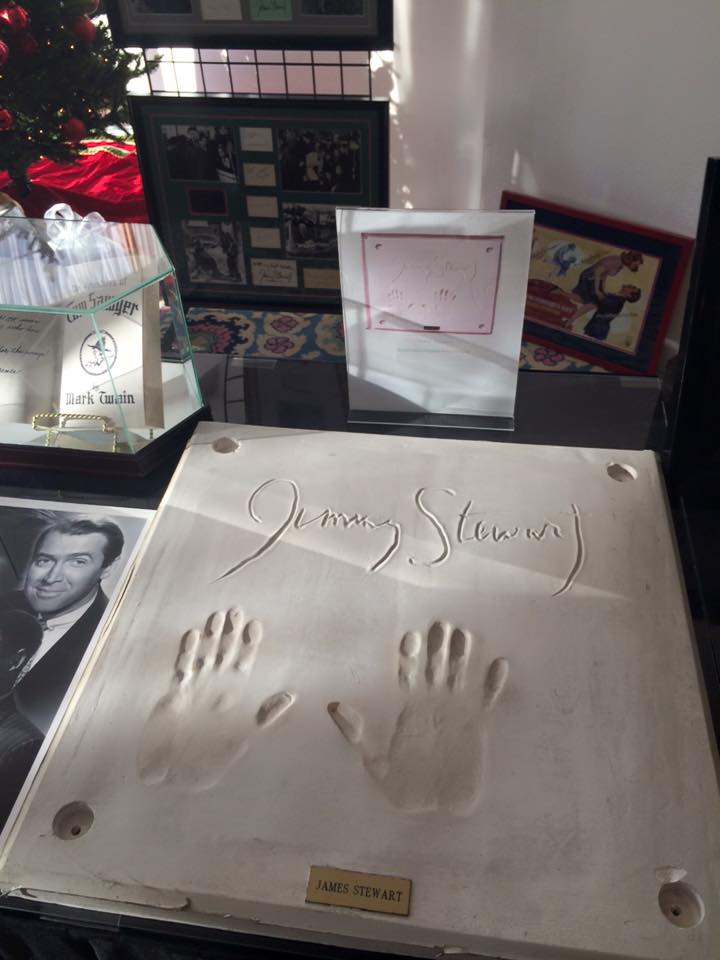
So who is he? Only one of the biggest collectors of It's a Wonderful Life memorabilia. While my collection includes store-bought village pieces, Christmas tree decorations, lots of angels and LOTS of bells, Goodson collects the less commercial, more meaningful, ephemeral stuff. For example, he has two sets of earrings that Gloria Grahame (Violet) wore in the film. He recently collected photos of Jean Gale (who played young Mary Hatch) as a child. He even has checks written by Marian Carr, who played Jane Wainwright, an uncredited role. His collection is so extensive, here are a few pictures because my words can't do it justice:
Impressive, right? That's not even half of it.
Anyway, Goodson provides photos for authors, as well. He takes his display around to festivals and events and hangs out with Karolyn Grimes (Zuzu) on a regular basis.
So I'm not stupid. I accepted the friend request. Almost immediately, he starts up a chat with me. Okay, I'll bite. He starts talking about how he has stories he wants to tell me. And suddenly I get an idea.
I have this blog, see. And at work, I co-host a podcast about prevention. Prevention of what you ask? Drug abuse, alcohol abuse, gambling, destructive behaviors, mental health issues, suicide. Basically, if it hurts you, we work to prevent it and help people through it when they find themselves fighting against it.
Our podcast began in September and we worked diligently (and successfully) to fight the commercialization of marijuana in Ohio in November. We have run a number of episodes about the opiate epidemic, as well as episodes about distracted driving and other issues. The plan was to record and post an episode about the Parents Who Host Lose the Most campaign, which warns parents of the dangers and consequences of hosting an underage party and serving alcohol this week before our office closed for a two-week holiday break. That fell through and there wasn't Plan B.
It's a Wonderful Life is a passion of mine (if you hadn't guessed). It's timely for the holiday, and it was on-topic for work! So within 10 minutes of meeting Mr. Goodson on Facebook, I was asking him to record a podcast with me. To my surprise, he was open to it, and within 45 minutes of meeting him, we were recording.
Unfortunately, due to timing and illness and out-of-town meetings, we were unable to augment this podcast with commentary from a suicide prevention specialist or psychologist, so we couldn't use it as a holiday special. However, my boss was willing to allow me to post it on my blog, so here it is.
Mr. Goodson and I talked about a lot more than what was captured on audio. I hope Mr. Goodson and I can continue our discussions and share more stories as time goes on. Thank you Mr. Goodson, for reaching out to me and for sharing your collection and knowledge with the world.
I'll stop typing now and let you listen to the podcast, which consists of a discussion between two passionate collectors of IAWL memorabilia. I hope you enjoy.
I've mentioned it before and I'll say it again: TALK to somebody. People like Potter are in the vast minority. Someone out there can help you. Don't be afraid to reach out and ask for help. Life can be hard but it's worth fighting for. So FIGHT!
In my movie reviews, I give my brief thoughts on what I watched. Sometimes I will expound on those thoughts, but more often than not, I will just give a brief opinion. You can read plot descriptions on Internet Movie Database or on Amazon.
Ziegfeld Girl. Starring James Stewart and Judy Garland. 1941.
Crap. It's a musical.
I'm sure it's great if you're into musicals. But I'm more into movies that progress forward. Musicals, for me, seem to introduce an idea and then spin its wheels and dwell on it for about 4 minutes at a stretch while someone drones on and on and on about it.
In my book reviews, I give my brief thoughts on what I read. Sometimes I will expound on those thoughts, but more often than not, I will just give a brief opinion. I could go into detail about what the book is about, but a lot of people have already done that. You can read their descriptions of the book, plus the official description on Amazon.
Jimmy Stewart and His Poems, by Jimmy Stewart. 1989.
Jimmy Stewart wrote some verse
That made my English professor curse
He said it was not poetry, but worse
It was an assignment that I turned in ... my first.
Years later I know he was right
The book it really stunk
And yet I keep it next to Plath and Ginsberg
Tucked inside a trunk
Two copies of Stewart's poetry that I have in my collection.
Okay, I'm done.
I know the poetry above is not in any consistent meter. I know the rhymes are not in a consistent pattern. Neither are Stewarts. So not only are my verses above acceptable for this review, they are intentionally bad.
Don't expect anything high-minded here. You won't find Stewart's poetry in any classrooms...at any level. But that's okay. They don't beg analysis. They don't beg interpretation. They are intended to be entertaining and gain a few laughs.
There are only four poems in this book. All of them are preceded by a short explanation of their creation. Of the four poems, three of them are about Stewart's travels to foreign countries:
The Top Step in the Hotel Junin
The Aberdares!
I'm a Movie Camera
I found this letter to Dear Abby in my copy with the cartoon dust jacket. I had forgotten
I had put it there. To be honest, I don't even remember it. But it gives you an idea of
how Stewart wrote.
A fourth poem, titled "Beau" is about the family dog.
Sadly, Stewart believes that in order to be poetry, the lines must rhyme. I strongly disagree with him, but who am I to argue with Jimmy Stewart?
3 out of 5 starts, but only for cuteness, not for quality of the poetry!
In my book reviews, I give my brief thoughts on what I read. Sometimes I will expound on those thoughts, but more often than not, I will just give a brief opinion. I could go into detail about what the book is about, but a lot of people have already done that. You can read their descriptions of the book, plus the official description on Amazon.
Jimmy Stewart: A Wonderful Life, by Frank Sanello. 1997.
This book seems to have been finished in a rush following Stewart's death in July, 1997.
Stewart's life from 1908-1969 spans 271 pages. The years 1970 to his death are covered in just 9 pages, including his own death and that of his wife. Those last nine pages also quote heavily from the barely more than one-page afterword by Stewart's daughter.
I found at least three errors in this book, including a misspelled word, a repeated word. Sanello also is very repetitious, constantly repeating the same old stories, such as when Stewart was awarded for failing during a WWII bombing mission, which saved some historically significant items.
The book also touches only briefly on the friendship between Stewart and Ronald Reagan. Save your money and your time. Invest them instead on another Stewart biography...ANY OTHER Stewart biography.
In my book reviews, I give my brief thoughts on what I read. Sometimes I will expound on those thoughts, but more often than not, I will just give a brief opinion. I could go into detail about what the book is about, but a lot of people have already done that. You can read their descriptions of the book, plus the official description on Amazon. Jimmy Stewart: A Wonderful Life, by Jonathan Coe, 1994.
I am not a happy man. I had used this book for research when I wrote a lengthy college paper about the portrayal of capitalism in the film It’s a Wonderful Life. I did not read it all at that time, and upon reading it now, I am very angry with Coe.
It's a Wonderful Life, along with several other Stewart films, such as Mr. Smith Goes to Washington and You Can’t Take it With You, are distinctly American films portraying distinctly American ideals, so it is preposterous (yet intriguing and enlightening) to see Coe, who lives in England, review Stewart and his films.
This book is a quick run-through of Stewart's films, telling few anecdotes about the films, and ignoring most of the rest of his life. The birth of his twin daughters received only a sentence or two. Coe brings up a few good points arguing that the main argument of It's a Wonderful Life and other Stewart-Capra films are flawed. However, I can refute these claims and show how these films DO work under an American ideology.
Coe pans most of Stewart’s films and tosses them off generally as just more half-hearted films that fail in their sentimentality and half-baked scripts. Coe apparently only liked a handful of Stewart’s films, according to what he wrote in his book. A sample sentence on page 188, offering a summary of Stewart’s film career, states “It’s a long time now since he (Stewart) made a film, and an even longer time since he made a really good one.”
My question to Coe is: Wouldn’t it have been more fun for you to write a book about someone who’s work you overall enjoyed, as opposed to someone who’s work you have a hard time finding much good to talk about? This book is worth reading for die-hard Stewart fans, only to get a non-American perspective of Stewart and his films.
In my movie reviews, I give my brief thoughts on what I watched. Sometimes I will expound on those thoughts, but more often than not, I will just give a brief opinion. You can read plot descriptions on Internet Movie Database or on Amazon. An Ameican Tail: Feivel Goes West. 1991. Starring Phillip Glasser and Jimmy Stewart.
Ehh...it's okay, but...ehh. It starred Jimmy Stewart as Wylie Burp, so that's a good thing!!!
I give it 2 stars out of 5. The kids might fight me for more.
This is a special week for this blog. This week, is completely dedicated to the film Harvey. Be sure to check it out on Wednesday and Friday. I will even take a break from my pictures of bells in order to post a Harvey-related photo. I hope you enjoy.
In my movie reviews, I give my brief thoughts on what I watched. Sometimes I will expound on those thoughts, but more often than not, I will just give a brief opinion. You can read plot descriptions on Internet Movie Database or on Amazon.
Harvey. Starring Jimmy Stewart and Josephine Hull. 1950.
This is a great film, though a bit mysterious.
Based on a play written by Mary Chase, there is absolutely no doubt that Stewart's character, Elwood P. Dowd, an easy-going drinker, is absolutely nuts.
And then you get to the end of the film and question everything you have seen.
Who is crazy? Who is sane? How are those terms defined? Who defines them? What makes them so qualified? What quality of life do you want; that of the "sane" or that of the "insane"?
They are amazing questions to ponder.
This is a must-see for fans of Stewart and for fans of Pulitzer Prize-winning Broadway plays.
4.5 out of 5 stars
This Harvey poster used to hang in my IAWL/Stewart Tribute hallway,
and is part of my personal collection.
Here is the trailer:
Stewart reprised his role in the made-for-TV version of Harvey in 1972 for the
Hallmark Hall of Fame. I have never seen this version all of the way through .... nor can I find it anywhere to buy or rent .... but I post links to it here for you:
In my movie reviews, I give my brief thoughts on what I watched. Sometimes I will expound on those thoughts, but more often than not, I will just give a brief opinion. You can read plot descriptions on Internet Movie Database or on Amazon.
Rear Window. Starring Jimmy Stewart and Grace Kelly. Directed by Alfred Hitchcock. 1954.
Where do you draw the line between being a concerned neighbor and being a voyeur? Hitchcock explores this concept with this film.
A neighbor goes missing. Her husband mostly goes about his daily life as if nothing has happened. Can Scotty (Jimmy Stewart) solve the mystery before it's too late?
I have seen this film on the big screen twice and on DVD multiple times. It never gets old. It is interesting to see Stewart progress as he gets older. His characters get grittier as he gets older. There is less innocence and naïveté and more distrust and callousness.
And the fact that it is a Hitchcock film makes it even better.
In my movie reviews, I give my brief thoughts on what I watched. Sometimes I will expound on those thoughts, but more often than not, I will just give a brief opinion. You can read plot descriptions on Internet Movie Database or on Amazon.
The FBI Story, starring Jimmy Stewart and Vera Miles. 1959.
Source: http://goo.gl/68sukd
The FBI Story was not Stewart's first police/detective story. Nor was it his first film with a title taking the form of “The (Noun) Story.” Some other examples of those films include The Philadelphia Story, The Glenn Miller Story, and The Stratton Story.
In The FBI Story, we follow the life of Agent Chip Hardesty, who is portrayed by Stewart. The film is constructed under the premise that Hardesty is giving a lecture about the history of the bureau, his life, and his relationship with his family. It is a relationship that has seen better days.
There are several references to It’s a Wonderful Life and other Capra films, as well as at least one reference to Stewart’s real life.
Some of the parallels to It’s a Wonderful Life include when the Chip and Lucy Hardesty (Vera Miles) get married and it rains on their honeymoon. It also rained on the day of George and Mary’s wedding, which we first learn as they are leaving to go on their honeymoon.
Later on, Lucy tells Chip she is going to have a baby. When Chip acts dumbfounded and surprised, just as George Bailey did, Lucy responds to Chip’s flabbergasted question of what the child will be by responding in Mary-like fashion, “I presume it will be a baby.”
The Hardesty family has a difficult life with Chip working long hours and constantly placing his life in danger for the safety of others. The time away from his family begins to wear on Chip, as well. One night, he reaches his breaking point and re-words George Bailey’s angry and frightened lambasting of their home, saying, “This is a real wonderful place to raise a family. I’m getting out!” Eventually Chip is reunited with his children, and just as the reunion occurred in It’s a Wonderful Life, Hardesty is reunited with the children at the staircase, where the children proceed to climb on and cling to him.
Furthermore, Hardesty’s best friend and agent is named Sam, sharing a name with George Bailey’s best friend. Also during the film, the Hardesty family receives a telegram informing them of their son’s death. This is reminiscent of a young George Bailey reading a telegram sent to Mr. Gower informing him of his son’s death.
In real life, one of Jimmy and Gloria Stewart's sons, Ron McLean, was killed in action in Vietnam.
In what may be a further nod to Frank Capra’s films, The FBI Story includes inspirational footage of the reflecting pool and the Washington Monument from over the shoulder of Lincoln in his memorial, as well as footage of the Iwo Jima memorial. This is reminiscent of what we saw during the sightseeing scene in Mr. Smith Goes to Washington, and in the Why We Fight series.
One final, seemingly blatant reference to It’s a Wonderful Life must be mentioned here, as its placement at the end of the film appears to have been intentional. After giving his lecture to the class, one student approaches Hardesty and says, “From the different cases and what you said about your family, I think you’ve led a very interesting life.” Hardesty replies, “Well, I kind of hope so. It’s the only one I had.”
In my movie reviews, I give my brief thoughts on what I watched. Sometimes I will expound on those thoughts, but more often than not, I will just give a brief opinion. You can read plot descriptions on Internet Movie Database or on Amazon.
The Spirit of St. Louis. Starring Jimmy Stewart and Murray Hamilton. 1957.
This is a biopic about Charles Lindberg, with Mr. Lindberg portrayed by Jimmy Stewart. This is an appropriate role for him, because as a child, Stewart tracked Lindberg's flight. He kept track of the progress by marking a map that he set up in his father's store in Indiana, PA. That store was across the street from the current location of the Jimmy Stewart Museum.
This movie also holds a special place for me because, as I understand it, this is the first time my grandfather took my mother to see a movie. Not that I was there, but it's a fond memory for my mother, and she tells me the story often.
The Spirit of St. Louis is about more than the plane or the pilot, or even the flight. A hefty portion...maybe even half of the film...is based on Lindberg's struggle to find support, and what it took to get the plane built.
The oddity of the film is that half of it is spent in the plane, where Lindberg few alone. So for that entire half of the film, Lindberg talks to himself, and to a fly. But somehow, he pulls it off. Perhaps it has to do with Stewart's experience as a pilot during World War II.
James Maitland "Jimmy" Stewart, died on this day (July 2), in 1997.
He was born May 20, 1908 in Indiana, PA.
Jimmy (not James....Jimmy) almost didn't have to act. He lived an upright, honest life and was as trustworthy as George Bailey himself.
Stewart is often described as “Everyman” in his roles. Although it was a role he reprised several times, never was it more obvious than in the films he made under the direction of Frank Capra, including It’s a Wonderful Life and Mr. Smith Goes to Washington.
“The part of Jefferson Smith in Mr. Smith Goes to Washington constitutes the quintessential Stewart: the upstanding, all-American, small-town boy, loyal to his family, his country, his church and his ideals; the personification of ‘rock-ribbed honesty,’” said biographer Jonathan Coe (43).
This persona was not a new role for Stewart. It was a role he lived off of the screen, as well as on. Stewart grew up with strong family and religious ties in his home town of Indiana, Pa. Later in his life, this small town dedicated the Jimmy Stewart Museum as part of the Indiana, Pa. Library.[i] In 1985, a statue of Stewart was erected in front of the museum. It faces the lot where the J.M. Stewart and Co. Hardware store stood before it was razed in 1969.
Stewart biographer Jonathan Coe calls Stewart an “incorruptible American patriot” (9). Stewart was able to further solidify this image when he enlisted in March, 1941, and became an officer in the Army Air Corps and a bombardier pilot during World War II.
Coe has drawn parallels between Stewart’s real life and the life of George Bailey. Stewart signed on to It’s a Wonderful Life on Nov. 5, 1945 (Coe 78). In addition to coming from a background similar to George’s, Coe says Stewart was drawn to the part for another reason:
“There were reasons, in fact, why a story about a hero who feels ‘despondent’ might have exerted a strong personal appeal to him (Stewart) at this time, since he was profoundly shaken by his wartime experiences, which caused him to doubt both his faith and the fundamental worth of his career” (Coe 79).
Coe’s statement does two things. First, it suggests that Stewart’s despondency reflects the country’s feelings immediately following World War II. It could have been the same despondency that prevented It’s a Wonderful Life from being a box office success. Secondly, Stewart’s life at that time reflected It’s a Wonderful Life, with Stewart doubting his own faith and career, as George Bailey does in the film. George always talks about and dreams of being an engineer or an architect, but never about being an executive of a lending company. George constantly doubts his job and its value.
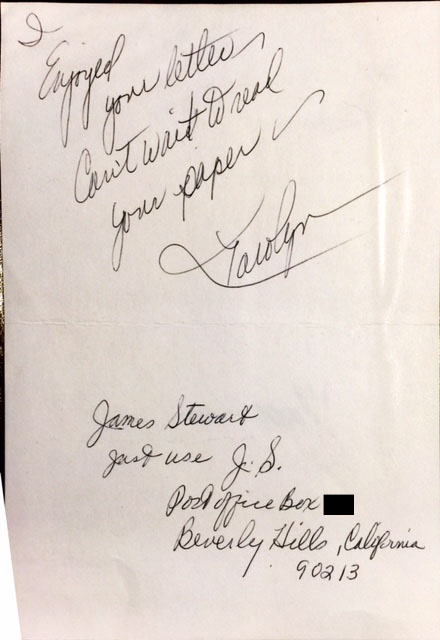
My note from Karoly in which she gave me
Stewart's address. (Source: Blogger's private collection)
Through my friendship with Karoly Grimes, who played George and Mary's youngest daughter, Zuzu Bailey, I was able to get Stewart's address. I came right out and asked her for it, and I expected it to be denied. I told her that I only wanted to send him a copy of my college research paper about the film. To my surprise, she gave me his address. I filed the letter away, graduated, was hired a job at at my hometown newspaper just two days after graduation, and moved into my first apartment.
I soon learned a hard lesson about not putting off until tomorrow what I can do today. On July 1, 1997, I was sitting on my porch when I realized that I hadn’t yet written to Jimmy, even though I had his address for nearly two months. It was late, so I decided to write to him the next day. As you may recall, he died July 2, the day I was going to write to him. That was a rough day for me.
This post is a tribute to Everyman....Jimmy Stewart. If he were alive, he would be 108 years old.
Here is a great interview with Stewart from 1989:
------- [i] The Jimmy Stewart Museum is located at 845 Philadelphia St., Indiana, PA, 15701. To contact the museum, call (724) 349-6112 or toll-free at 1-800-83-JIMMY, or e-mail curator@jimmy.org. Visit online at www.jimmy.org.
Source:
Coe, Jonathan. Jimmy Stewart: A Wonderful Life. New York: Arcade Publishing, 1994.
In my movie reviews, I give my brief thoughts on what I watched. Sometimes I will expound on those thoughts, but more often than not, I will just give a brief opinion. You can read plot descriptions on Internet Movie Database or on Amazon.
The Man Who Shot Liberty Valance. Starring John Wayne and Jimmy Stewart. (1962)
Source: http://goo.gl/BgpFjG
I have a confession to make.
I tried to watch this film many years ago and I hated it. With a capital HATED. My problem was that I only saw Stewart as George Bailey or Mr. Smith or Tony Kirby. My imagination was broken. The second problem was that I didn't like John Wayne. I know...that makes me un-American or something.
Why didn't I like John Wayne, you ask? Well, it had something to do with the way he talks. It's too slow. It's too drawn out and deliberate. I know. I'm a huge fan of Stewart and he did the exact same thing. Hypocrisy. Irony. I get it.
But what that did was it caused me to not watch any other Stewart western...or John Wayne western for that matter. Maybe I just have a problem with westerns.
So then along comes this blog, and I start thinking that I will just start watching all of Stewart and Capra's films again. And I have to admit that my stomach did a slow roll when I thought about re-watching this film, or watching any of Stewart's bazillion other westerns (that's just a low estimate. I don't know how many there really are).
But apparently I have grown up or expanded my horizons or gotten old or my personality has hardened or something. Because I actually kind of liked it this time around. Perhaps I'll give Stewart's other westerns a shot.
So at this point in my life I will give it 3.5 out of 5 stars. But only because this entry feels more like a confession than a review.
James Maitland Stewart often is described as “Everyman.” Although it was a role he reprised several times, never was it more obvious than in the films he made under the direction of Frank Capra, including It’s a Wonderful Life and Mr. Smith Goes to Washington:
“The part of Jefferson Smith in Mr. Smith Goes to Washington constitutes the quintessential Stewart: the upstanding, all-American, small-town boy, loyal to his family, his country, his church and his ideals; the personification of ‘rock-ribbed honesty’” (Coe 43).
This persona was not a new role for Stewart. It was a role he lived off of the screen, as well as on. Stewart grew up with strong family and religious ties in his home town of Indiana, Pa. Later in his life, this small town dedicated the Jimmy Stewart Museum as part of the Indiana, Pa. Library.[i]
In 1985, a statue of Stewart was erected in front of the museum. It faces the lot where the J.M. Stewart and Co. Hardware store stood before it was razed in 1969.
Stewart biographer Jonathan Coe calls Stewart an “incorruptible American patriot” (9). Stewart was able to further solidify this image when he enlisted in March, 1941, and became an officer in the Army Air Corps and a bombardier pilot during World War II.
Coe has drawn parallels between Stewart’s real life and the life of George Bailey. Stewart signed on to It’s a Wonderful Life on Nov. 5, 1945 (Coe 78). In addition to coming from a background similar to George’s, Coe says Stewart was drawn to the part for another reason:
“There were reasons, in fact, why a story about a hero who feels ‘despondent’ might have exerted a strong personal appeal to him (Stewart) at this time, since he was profoundly shaken by his wartime experiences, which caused him to doubt both his faith and the fundamental worth of his career” (Coe 79).
Coe’s statement does two things. First, it suggests that Stewart’s despondency reflects the country’s feelings immediately following World War II. It could have been the same despondency that prevented It’s a Wonderful Life from being a box office success. Secondly, Stewart’s life at that time reflected It’s a Wonderful Life, with Stewart doubting his own faith and career, as George Bailey does in the film. George always talks about and dreams of being an engineer or an architect, but never about being an executive of a lending company. George constantly doubts his job and its value.
Stewart married Gloria Hatrick McLean. He adopted her two sons, Ronald and Michael Stewart. Together Stewart and Gloria had twin daughters, Kelly Stewart-Harcourt and Judy Stewart-Merrill.
James Stewart died July 2, 1997 at age 89. If he were still alive, he would be 107.
[i] The Jimmy Stewart Museum is located at 845 Philadelphia St., Indiana, PA, 15701. To contact the museum, call (724) 349-6112 or toll-free at 1-800-83-JIMMY, or e-mail curator@jimmy.org. Visit online at www.jimmy.org.
Sources:
Coe, Jonathan. Jimmy Stewart: A
Wonderful Life. New York: Arcade Publishing, 1994.
In my movie reviews, I give my brief thoughts on what I watched. Sometimes I will expound on those thoughts, but more often than not, I will just give a brief opinion. You can read plot descriptions on Internet Movie Database or on Amazon.
An American Tail: Fievel Goes West. Starring Phillip Glasser, Jimmy Stewart, Erica Yohn. 1991.
Source: http://goo.gl/0rv4mk
As Jimmy Stewart's last film, I really want to like this movie. I just can't manage it. An American Tail: Fievel Goes West was released in 1991. Stewart died in 1997 at the age of 89.
The movie opens with Stewart's character, Wylie Burp, but he doesn't show up again until about 40 minutes into the movie.
Watch Fievel Goes West if you have kids. Watch it if you want to be a Stewart film completist. But it certainly isn't a Disney movie.
Interestingly, Stewart played Wylie Burp in this film and starred as Wyatt Earp in the 1964 film, Cheyenne Autumn.
Welcome to the It's A Wonderful Blog's Blogging From A to Z April (2015) Challenge. For this challenge, I will post every day in April (except for Sundays) about topics related to the Frank Capra/Jimmy Stewart film, It's a Wonderful Life. You Can't Take it With You:
You Can’t Take it With You was the first of three films made by the film team of Frank Capra and Jimmy Stewart.
While Capra borrowed several techniques, ideas and themes from many of his films, a great deal of them began in this film. There are so many connections that it will require one very long blog entry, or several shorter entries. I will work on those at some point.
One major connection to that You Can't Take it With You has with It’s a Wonderful Life is the list of talent.
Jimmy Stewart played George Bailey in It’s a Wonderful Life. He played Tony Kirby in You Can’t Take it With You.
Samuel S. Hinds played Pa Bailey in t’s a Wonderful Life. He played Paul Sycamore in You Can’t Take it With You.
H.B. Warner played Mr. Gower in t’s a Wonderful Life. He played Ramsey in You Can’t Take it With You.
Lionel Barrymore played the much-hated Henry F. Potter in t’s a Wonderful Life. He played the much-loved Martin Vanderhof in You Can’t Take it With You.
For now, I want to focus on Peter Bailey.
During the bank run, George takes a phone call from Potter. After that discussion, George turns to a framed picture of his father on the office wall. Three characters from You Can’t Take it With You are reunited in this scene.
As George turned to his father for advice as a child, he continues to do so as an adult, looking for the guidance and strength that Peter represented in life. It is the same picture that will hang on the wall at George and Mary’s future home. Both at home and at work, this picture can always be seen over George’s shoulder whenever he meets opposition or is faced with trouble.
At work, though, there is a quotation beneath the picture that says, “All you can take with you is that which you’ve given away.” In this way, Capra brings the message of You Can’t Take it With You into t’s a Wonderful Life, and makes a reference to his previous film at the same time. This quotation was not hanging under the photo when George took over the business, but it is there during the bank run.
This quotation is more than just Peter’s epitaph. Raymond Carney, author of American Vision: The Films of Frank Capra, points out that “George’s father represents a sense of responsibility and obligation to the larger community and a belief in the value of self-sacrifice for the common good that almost all of the earlier (Capra) films advocated” (386). George has gained his father’s values, and the audience is led to believe by the end of the film that these values will in turn be passed down to George and Mary’s children.
The quotation also helps to enforce the film’s message of civic-mindedness. It contradicts the ideology of the period that capitalism is about personal gain despite negative consequences for others, as Potter represents. By showing the Baileys as civic-minded capitalists, Capra has challenged America’s post-World War II ideology in t’s a Wonderful Life. He works to affirm an ideology of civic-minded capitalism throughout the film through the photograph of Peter, through George’s struggles, and in the contrast between the Baileys and Potter.
As author Greg Asimakoupoulos puts it, “When you make deposits in the lives of others, you aren’t always aware of the compounding interest that is taking place. But the bottom line reveals a wealth that exceeds your expectations.”
Sources:
Asimakoupoulos, Greg. “Finding God in It's A Wonderful Life.” iBooks. https://itun.es/us/d0e1H.l
Carney, Raymond. American Vision: The Films of Frank Capra. Cambridge: Cambridge University Press, 1986.